Showing posts with label Hazard. Show all posts

Sunday, January 12, 2020

Orlando Home Fire Cause by Dirty Dryer & Duct

Not Cleaning the Clothes Dryer and Duct is the Major Cause of Orlando Dryer Fires!

Modern home appliances are safer today than they were just a decade ago, but the amount of fires has not decreased. Failure to clean the dryer and ducts accounts for more than 34 percent of the dryer fires in the United States. This is the leading cause of home clothes dryer fires. Other causes include manufacturing defects and poor installation. Foreign manufacturing and foreign component suppliers are another cause. Increasing quality issues are associated with the extremely rapid growth of fires connected with appliances. More home clothes dryer fires occur in the fall and winter months and peak in January. 
You should check your dryers and appliances out for manufacturer defects and recalls at https://www.cpsc.gov/Recalls .

What Type of Dryer is Your Home Designed for?

The dryer manufacturers set limits of the length and type of duct that can be used with their dryers. These limits are based on the type of equipment installed in the dryer. Damp lint requires a certain volume of air to move it through the ducts. Homeowners will often select a dryer and make it fit their house. Some dryers are designed with larger motors and fans to move the lint farther.  Economy or inexpensive dryers often have the smallest motors and fans. All dryers are not created equal.  

Dryer Duct Design and Orientation Limits the Length .

The type of duct material, vent hood, the number of turns the duct and orientation, horizontal or vertical affect the length of the duct.  Below is the dryer manufacturers' requirement based on the model of dryer.
Manufacturer's recommendation for Dryer Vent length and type.

Mechanical fasteners cause lint to accumulate inside the duct and reduce air flow.  Dryer duct inspection in Volusia County.
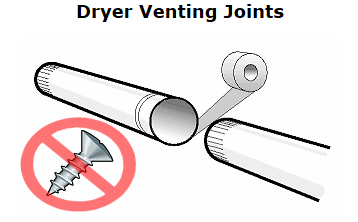
Ducts should have no mechanical fasteners.
The type of material used for the duct is very important in venting lint and moisture. Each 90-degree turn decreases the length of the duct by 5 feet. The use of a flat hood decreases the length by half. Using flexible vent ducts also cuts the length by half.  Rigid metal ducts are required to be taped at the joints and not fastened by screws.  The screw shank protruding into the duct creates and place for lint to accumulate.
Winter Park clogged dryer vent.  Fire Hazard!  Olando Home Inspection, (386) 624-3893
Flexible and vinyl ducts are not allowed
because they collect lint and are a fire hazard!


Homeowners often choose flexible metal or vinyl duct for their ease of installation. These types of ducts are not allowed for use on a dryer in many areas due to the fire hazard. Flexible ducts have many areas for lint to accumulate within the duct. Vinyl and PVC when heated create an electrostatic charge that attracts lint, these are not allowed.  Most municipalities and building codes require rigid metal ducts without mechanical fasteners. These rigid ducts have fewer areas to collect lint and obstruct the airflow.

Fire Hazard!  Gooseneck dryer vents on roof need yearly maintenance.  Longwood Home Inspection, (386) 624-3893
Clogged gooseneck dryer vent on the roof.

Gooseneck dryer vent hoods are common in Deltona and often clogged due to the location on the roof. The homeowners are either unaware of them or just forget about them until they become a problem. Most of these types of vents we inspect are clogged. Many of these types of vent hoods when clogged cause the duct to separate in the attic. Damaged ducts pump moisture and lint into the attic causing moisture damage, wood rot and mold growth. Gooseneck hoods because of their location on the roof should be scheduled for yearly inspection and cleaning by a professional. 

Annual Dryer Duct Inspection and Cleaning

All dryer ducts should be inspected and cleaned yearly. Check with your Home Inspector when you buy your home. A dryer duct inspection may reveal improper installation or materials. If you have a larger family and use the dryer daily or more often, your ducts may require semi-annual cleaning. Less frequent use may only require biennial cleaning.  Protect your family and sleep soundly at night.  Have your ducts inspected and cleaned in the fall when you change your smoke detector batteries. 


Best Orlando Home Inspector, Best Orange County Home Inspector, Best Windermere Home Inspector, Best Lake Butler Home Inspector, Best Ocoee Home Inspector, Best Winter Park Home Inspector
Frank Carr, Florida Licensed Home
Inspector
Frank Carr is the Owner / Inspector at First Choice Home Inspections in Deltona, FL serving Volusia, Seminole, Orange and Lake Counties. Formerly in the building trades, Frank’s focus is a safe home in the Orlando Metro and Daytona Beach areas of Central Florida and building FCHI. We believe that consumers have the right to expect the highest standards of thoroughness, fairness and effectiveness from their home inspector and that is exactly what we provide.
 
First Choice Home Inspections
Residential Home Inspections in Central Florida
(386) 624-3893 


Friday, November 4, 2016

Orlando Fire Hazards from Clogged Dryer Vents


We started blogging about clogged goose neck dryer vents in 2011, today we still see just as many every day in the Orlando area during the home inspection process.  Because they are located on the roof, the homeowner does not see them and they are mostly overlooked until the dryer is not working or worse a fire happens.

As a home inspector, one of the biggest safety hazards I see daily is dryer vents.  Dryer fires are among the top ten reasons for home fires and cause more than 15,000 fires annually.  Dryer exhausting through the roof should duct to a special dryer roof vent without screen.   

The roof vent or louvered plenum must be equivalent to a 4 inch wall termination in regard to resistance to airflow and back-flow prevention, and should require little or no maintenance to prevent clogging.


Home inspection, Orlando, FL, roof inspection, clogged dryer vent, fire hazard, Orange County, Florida, home inspector,
Home built in 2013 goose-neck looks shiny and new.


Home Inspection, Orlando, FL, Orange County, Florida, Home Inspector, dryer vent
2013 home inside of goose-neck vent.

There are many issues with this type of vent.  It must be a vent that has a back-flow prevention flap and it should not have a screen.  Many of the goose-neck type of vents come with screens and are unsuitable for dryer venting.  
home inspection, roof inspection, dryer vent, Orlando, FL, Orange County, Florida
Goose neck vent with a screen


home inspection, Orlando, FL, lake mary, Orange County, Florida, dryer vent, roof inspection, longwood, home inspector,
Totally blocked dryer vent.


roof inspection, home inspection, Orlando, FL, Orange County, Florida, clogged dryer vent,
Inoperable back-draft damper.

home inspection, orlando, fl, orange county, florida, clogged dryer vent, winter springs, home inspector
Goose-neck with screen was clogged.  Improper duct type.
Lint exhausted into attic damaging roof decking.


  1. Dryer ducts must be at least 4 inches in diameter or at least the size of the dryer outlet. The exhaust duct must not extend into or through heating or air-conditioning ducts. The exhaust duct system should be supported and secured by mechanical fasteners. It should be insulated in non-conditioned spaces to prevent condensation.
  2. The maximum length for a clothes dryer exhaust duct should not exceed 25 feet. This length should be decreased by 2.5 feet for every 45-degree bend the duct makes, and 5 feet for every 90-degree bend the duct makes.
  3. The dryer exhaust ducts should be constructed of rigid metal (galvanized steel). The interior of the duct should be smooth surfaced with the joints running in the direction of the airflow. There should be no sheet-metal screws, rivets or any other fastener used to connect the duct joints. Fasteners that penetrate into the airway will catch lint and block airflow. 
  4. Foil duct tape (not plastic or vinyl) should be used to secure joints. Outside termination must be equipped with a back draft damper, which prevents air, moisture and rodents from entering. The termination must not have a screen covering the exhaust outlet.


I have seen all of these used for dryer roof vents.  Just because they are sold at the hardware store does not make them right.

 According to the IRC:
- M1502.3 Duct termination.
- - Exhaust ducts shall terminate on the outside of the building.  Exhaust duct terminations shall be in accordance with the dryer manufacturer’s installation instructions.  If the manufacturer’s instructions do not specify a termination location, the exhaust duct shall terminate not less than 3 feet (914 mm) in any direction from openings into buildings.  Exhaust duct terminations shall be equipped with a back draft damper.  Screens shall not be installed at the duct termination.

types of goose neck vents, home inspection, roof inspection, orlando, fl, orange county, florida, home inspector
In the opinion of this home inspector, the biggest problem I see with the roof vent is out of sight out of mind.  Each year many people die in home fires that start at the dryer.  Prevention is often easy and requires little effort.  Dryer vents should be cleaned annually but in the case of roof top vents I recommend semi-annually.  


licensed home inspector, owner of First Choice Home Inspections, home inspector, Florida, Orlando, Orange County, Longwood, Winter springs
Frank Carr is the Owner / Inspector at First Choice Home Inspections in Deltona, FL. Formerly in the building trades, Frank’s focus is a safe home and building FCHI. We believe that consumers have the right to expect the highest standards of thoroughness, fairness and effectiveness from their home inspector and that is exactly what we provide. Http://1homeinspector.com


First Choice Home Inspections 
(386) 624-3893
Email:  home.inspections@aol.com
Website: 
Http://1homeinspector.com
Facebook:  https://www.facebook.com/FirstChoiceHomeInspectionsLlc

Thursday, June 23, 2016

Orlando BBQ grills are a Leading Cause of Home Fires!

Barbecue grill are the #10 leading cause of home fires in the United States.  With the 4th of July weekend coming up and summer grilling kicking off, now is the time to check your grill and review BBQ grilling safety.  Grilling steaks and burgers with your family will make a great summer time gathering. A home fire will make your summer commencement barbecue unforgettable for all the wrong reasons.  The Consumer Product Safety Commission (CPSC) reported that there were 3,800 grill injuries reported annually requiring medical care.

Orlando Barbecue 4th of July

Before grilling check your equipment, review safety procedures with your party and children, and ensure you have proper clearance from combustible material.  Have your home fire extinguisher or garden hose in a handy location.  Keep children and pets away from the grill area and never leave your grill unattended.


  • Propane and charcoal BBQ grills should only be used outdoors. 
  • The grill should be placed well away from the home, deck railings and out from under eaves and overhanging branches. 
  • Keep children and pets away from the grill area. 
  • Keep your grill clean by removing grease or fat buildup from the grills and in trays below the grill. 
  • Never leave your grill unattended.


 BEFORE BARBECUING


  • Grill maintenance, check thoroughly for leaks, cracking or brittleness before using it.  Propane grills clean out the tubes that lead into the burner.
  • Make sure the grill is at least 10 feet away from your house, garage, or trees.
  • Store and use your grill on a large flat surface that cannot burn (i.e. - concrete or asphalt).
  • Grills should not be placed in a garage, porch, deck or on top of anything that can catch fire.
  • Establish a safety zone around the grill area.  Keep children away from fires and grills. Instruct children to remain outside the zone. A chalk line works great for this purpose.
  • Have a fire extinguisher, a garden hose attached to a water supply, or at least 4 gallons of water close by in case of a fire. 

 DURING BARBECUING 

  • Don't wear loose clothing that might catch fire.
  • Use long handled barbecue tools and/or flame resistant mitts.
  • Never use any flammable liquid other than a barbecue starter fluid to start a fire.
  • Never pour or spray starter fluid onto an open flame. The flames can easily flashback along the fluid's path to the container in your hands.
  • Alcoholic beverages are flammable.  Keep them away from the grill.
  • Never leave the grill unattended.

 AFTER BARBECUING


  • Always follow the manufacturer's cleaning and storing instructions for the grill.
  • Keep your grill clean and free of grease buildup that may lead to a fire.
  • Never store liquid or pressurized fuels inside your home and/or near any possible sources of flame.


IN CASE OF A BARBECUE FIRE

barbecue propane tank fire Winter Park
  • PROPANE Grills - turn off the burners.  If you can safely reach the tank valve, shut it off.  If the fire involves the tank, leave it alone, evacuate the area and call the fire department (911).
  • CHARCOAL Grills - close the grill lid. ELECTRIC Grills - disconnect the power.
  • DIAL 911 - If there is any type of fire that either threatens your personal safety or endangers property.
  • Grease fires - NEVER attempt to extinguish with water. It will only cause the flames to flare up. Use an approved portable fire extinguisher.


PROPANE GRILLS


The CPSC reports that more than 500 fires and 20 injuries occur every year from gas grill fires and explosions of grills that have not been used for several months.

20lbs propane tank Winter Springs
  • Check the tubes leading to the burner regularly for blockages. Check with your specific grill manufacturer's instructions.
  • Check for leaks EVERY TIME you replace the cylinder. Pour soapy solution over the connections and if bubbles begin to form, there is a leak. Placing the soapy solution into a spray bottle makes it much easier to apply. If there is a leak, turn off the grill IMMEDIATELY and have it fixed. Do NOT use the grill until the leak is fixed.
  • Make sure all the connections are secure BEFORE turning on the gas.
  • Never start a propane grill with the lid closed. Gas can accumulate and when the grill is ignited may cause an explosion.
  • Only get propane from approved compressed gas suppliers.
  • Before getting a propane cylinder filled, check for any damages to it.
  • Never store propane cylinders indoors or near any heat source.
  • Never transport or store propane cylinders in the trunk of your automobile.
  • ALWAYS shut off the propane fuel at the grill and at the bottle after you have finished barbecuing. Otherwise, this will lead to fire hazards, such as leaks and faulty regulators.


CHARCOAL GRILLS


Twenty deaths and 400 injuries are treated resulting from carbon monoxide poisoning from charcoal grills according to the CPSC.


  • Due to the production of carbon monoxide when charcoal is burned, charcoal grills should not be used inside homes, vehicles, tents, or campers, even if ventilation is provided. Carbon monoxide is odorless and colorless; you will not be alerted to the danger until it is too late.
  • Never use any flammable liquid other than barbecue starter fluid to start a charcoal barbecue.
  • Use the starter fluid sparingly and never put it on an open flame.
  • Never add fire starter after you have started your barbecue to speed a slow fire or rekindle a dying fire. The flames can easily flashback along the fluid's path to the container in your hands.
  • Remove the charcoal ashes from the grill and place them into a metal container with a tight-fitting metal lid. Add and mix in water with the ashes, and set aside for several days. Dispose of the mixture in accordance with the Department of Sanitation's guidelines.
  • Remove the ashes only after they are completely cooled and no warm embers remain.
  • Always soak coals with water after cooking; they retain their heat for long periods of time.
  • Keep damp or wet coals in a well-ventilated area. During the drying process, spontaneous combustion can occur in confined areas.


ELECTRIC GRILLS


  • Keep the grill at least 10 feet away from any combustible material.
  • Do NOT use any flammable liquid to start an electric grill.
  • Follow the manufacturer's instructions in the use of an electric grill.
  • When using an electrical extension cord, make sure it is properly rated for the amperage required for the electric grill. Route extension cords out of the line of foot traffic to avoid trip hazards.


DEEP FRYERS


According to the National Fire Protection Association (NFPA), deep fryer fires cause an average of 5 deaths, 60 injuries, and more than $15 million in property damage each year.


Basic safety principles when using deep fryers: 

Oil Level- If the cooking pot is overfilled, the oil may spill out of the pot when the turkey is lowered in. Oil can hit the burner and cause a significant fire. Follow the owner's manual and make sure the oil level is at the proper level. 

Frozen or Partially Thawed Meat in Oil - Frozen or partially frozen fowl placed into the fryer can cause the oil to spill over the pot and may result in a significant fire or burn injury. Do not use water to thaw your turkey. Make sure your fowl is properly thawed and slowly lower it into the pot to prevent the oil from splashing. 

Placement of Deep Fryer  - Cook outdoors and on a level, firm, and non-combustible surface.  Home fires involving fryers can start in a garage or on a patio or deck. Maintain a safe distance from any buildings and keep the fryer off of any wooden structures.


Don't Use Water or Ice - When ice or water comes into contact with hot oil, the water vaporizes, causing steam bubbles to pop and spray hot oil. Do not use ice or water to cool down oil or extinguish an oil fire. Keep an extinguisher approved for cooking or grease fires nearby and immediately call 911 for help. 

Don't Leave Your Fryer Unattended - Frying involves cooking with a combustible cooking oil or grease. Many frying units do not have thermostat controls and if unwatched, the oil will continue to heat until the oil ignites.  

Level Surfaces - Many fryers are very top-heavy and can be unstable if not used on a level surface. Fryers not on level surfaces can tip over causing a significant fire or burn injury.


REMEMBER


  • Never use a propane barbecue grill on a balcony, terrace or roof.
  • Never use a charcoal or propane grill inside your home or garage.
  • Propane tanks - no more than two (2) 20-pound propane tanks are allowed on the grounds of a one or two-family home, but be sure to follow the fire safety precautions above. 
  • Only use a charcoal barbecue on a balcony or terrace if there is a ten foot clearance from the building and there is an immediate source of water (garden hose or four (4) gallon pail of water).


Frank Carr Home Inspector First Choice Home Inspections

Frank Carr is the Owner / Inspector at First Choice Home Inspections in Deltona, FL serving Volusia, Seminole, Orange and Lake Counties.  Formerly in the building trades, Frank’s focus is a safe home and building FCHI. We believe that consumers have the right to expect the highest standards of thoroughness, fairness and effectiveness from their home inspector and that is exactly what we provide.
First Choice Home Inspections 
(386) 624-3893

Email:  home.inspections@aol.com
Website:  http://1homeinspector.com